01 — OVERVIEW
One Designer, Eight Perspectives
Porch Light Studio started as a bet: could one creative director, working with a roster of AI designer personas, deliver the range of a full design team without losing the human eye that makes the work matter? It runs out of The Neighborhood Creative Studio in Durham, North Carolina — big-agency range, porch-light warmth.
The first version won the bet. The second version earned it. Version one proved the personas could produce real range; it also had flaws I only saw once I watched it work. This case study covers both — because the rework is where the actual design thinking lives.
The point was never efficiency. It's access: neighborhood businesses and nonprofits deserve big-agency range without the Madison Avenue invoice.
02 — THE CHALLENGE
The Limits of One Perspective
No matter how good a designer gets, they bring one point of view — shaped by their teachers, their influences, their taste. I've spent a career hiring around that limitation, building teams where one person's blind spot is another's specialty. A solo practice doesn't get that luxury.
AI offered a way to widen the practice without pretending to replace it. The personas don't design instead of me; they argue with me. Each one is a perspective I can put on and take off, while I stay in the seat I'm best at: the art director who evaluates, tweaks, and decides.
The goal: eight points of view, one strategic spine, and no loss of the warmth this studio is named for.
03 — THE FIRST BUILD
Version One: Proof It Could Work
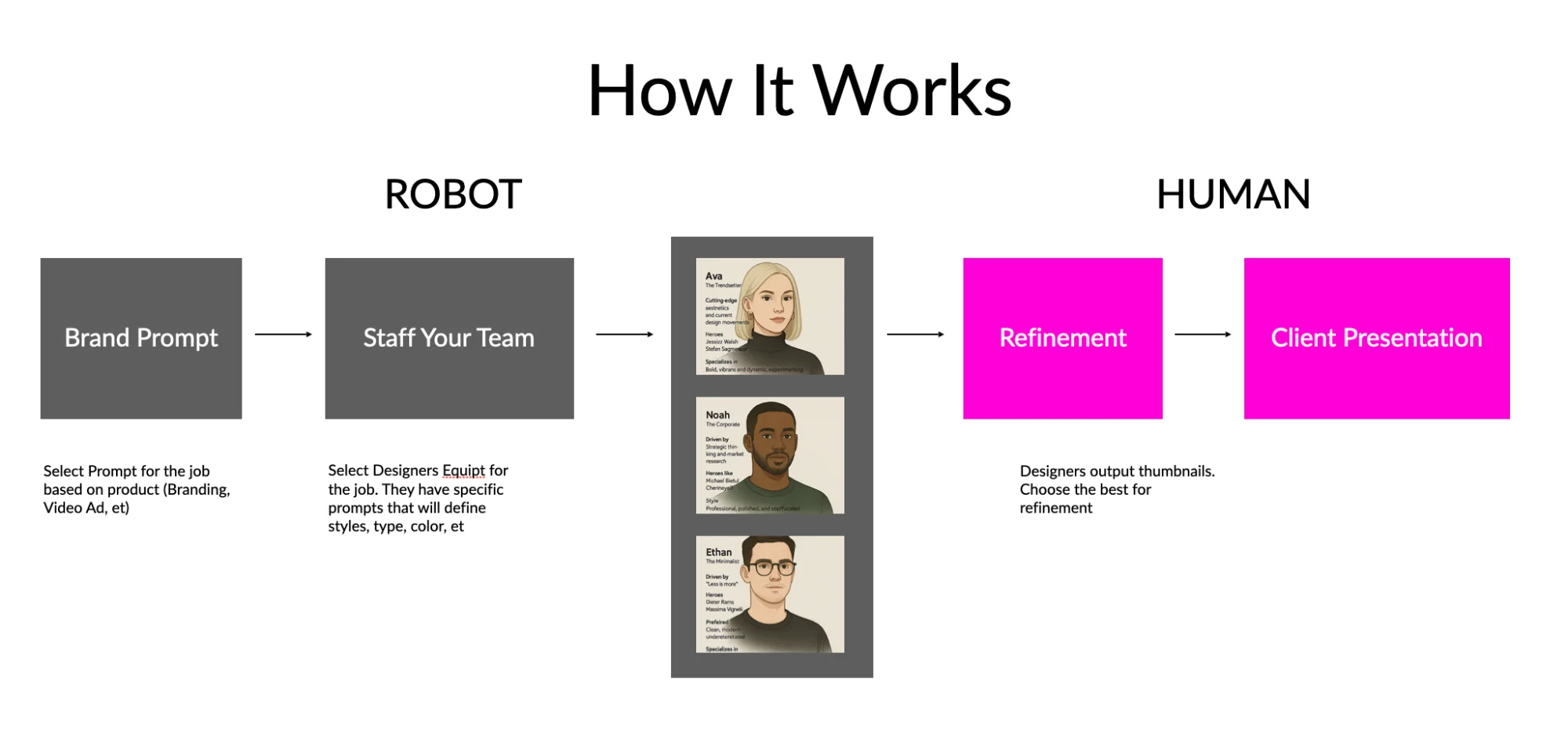
The capstone version got the big things right. Eight personas with real backgrounds, design philosophies, and hero mentors — Ethan quoting Dieter Rams, Emily raiding the zine archive. A brand brief that asked for company, industry, tone, and a spirit animal. A clean web tool where clients picked up to three designers and exported PDF concept decks.
It worked. Clients got a spread of directions no single designer would have handed them, and I got to watch five versions of myself disagree productively.
Then I watched people actually use it.
 04 — WHAT BROKE
Three Honest Problems
Every client got the same wardrobe
Ethan's palette never changed. Emily's fonts never changed. The personas were consistent the way a rubber stamp is consistent — press it a second time, get the same mark. That's not a point of view; that's a template with a backstory. A perspective should shape HOW a designer decides, not lock what they deliver.
The spirit animal went literal
The animal was always meant as a translator. A client who would never say "high contrast, formal, cool-tempered" can say Snake and mean exactly that. But the generator kept drawing the animal. Choose Tiger, receive tiger logo. The metaphor was doing its job in my head and none of it in the output — diagnosis had turned into decoration.
The order was backwards
Clients picked designers off their headshots before writing a word of the brief — swiping on style like a dating app, then hoping the match understood them. The brief should surface the designers, not the other way around. You don't cast the actor before you've read the script.
05 — THE REWORK
Version Two: From Template to System
Brief first, faces second
The flow now opens with the brief. An intake router reads tone, industry, and audience, scores all eight designers, and surfaces the top three with plain-language reasoning — "your bold and edgy tones and tiger energy point straight at Emily." The client still makes the call. The system recommends; it doesn't railroad.
The animal became an instrument
Each of the twelve zodiac animals now maps to six style attributes: energy, weight, formality, temperature, contrast, and character. Those attributes flow into every downstream decision — palette warmth, type weight, composition. And every persona carries the same hard rule: the animal never appears in the work unless the client explicitly asks. The client speaks in metaphor; the system translates.
Palettes and type became engines
Each designer now carries rules for deriving color and type from the brief instead of a fixed kit. Ethan picks between near-mono, single-bold, and tonal modes depending on the brief's temperature. Theo pulls palettes from actual landscapes. Every choice ships with a one-line rationale, and a no-repeat rule keeps any two projects from wearing the same clothes.
The studio became portable
The whole agency now lives in nine markdown files — one router, eight personas — that drop into ChatGPT or Gemini as a custom GPT or Gem. The web app builds the brief and hands off a ready-to-run packet: GPT Image for wordmark precision, Nano Banana Pro when the work needs texture you can almost feel.
06 — THE DESIGN TEAM
Eight AI Designer Personas
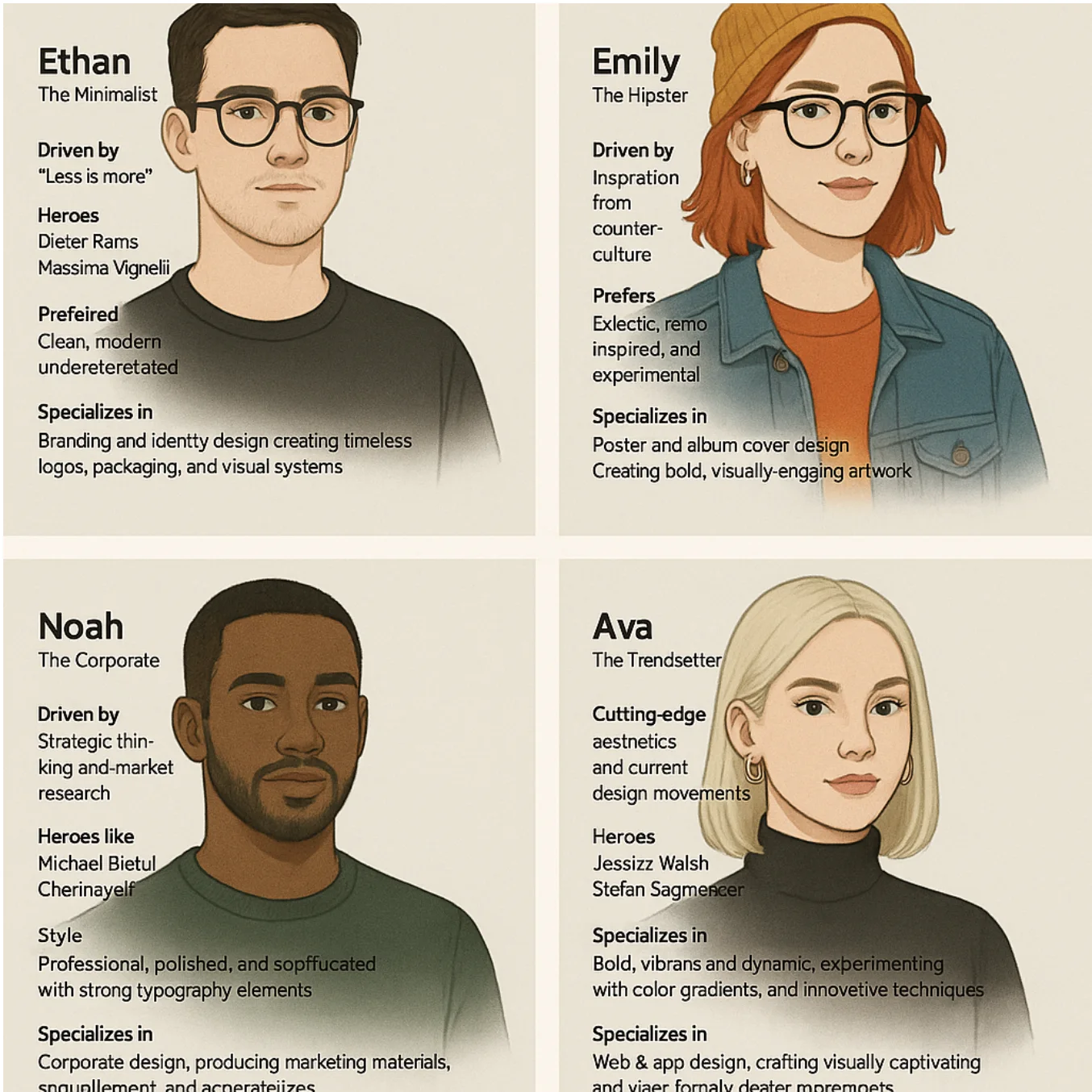
The original five stayed and got deeper. Three new hires — Maya, Theo, and Vivienne — cover the gaps the first roster left open: story, soil, and silk.
Ethan
THE MINIMALIST
Staunch believer in "less is more." Inspired by Dieter Rams and Massimo Vignelli, Ethan creates timeless elegance through restraint, precision, and perfect hierarchy. Believes a mark should survive being faxed.
Emily
THE HIPSTER
Free-spirited creator shaped by counterculture. Draws from vintage posters, zines, and Dadaist art. Heroes include Paula Scher and Milton Glaser. Vintage bones, current attitude — and always one notch weirder than you asked for.
Noah
THE CORPORATE
Strategic thinker bridging business goals with clean design. Inspired by Michael Bierut. Designs for the boardroom and the 16-pixel app icon at the same time. Every choice has a reason you could repeat to your CFO.
Ava
THE TRENDSETTER
Bold visionary at the intersection of art, fashion, and technology. Influenced by Jessica Walsh and Stefan Sagmeister. Lives six months in the future and will tell you — kindly — when what you asked for is already over.
Silas
THE CRAFTSMAN
Design alchemist obsessed with tactile processes. Letterpress, silkscreen, hand-inked type. Idolizes Jan Tschichold and Wolfgang Weingart. Makes marks that feel like they could be carved, stamped, or pressed into thick paper.
Maya
THE STORYTELLER
Editorial and illustrative, with a soft spot for brands that have a real story to tell. Heroes include Maira Kalman and Jessica Hische. Draws the moment you meet a brand — and the metaphor always comes from the client's actual history, never from stock charm.
Theo
THE NATURALIST
Organic, honest, unhurried. Pulls palettes from real landscapes and forms from nature's geometry. Heroes include Charley Harper and Aaron Draplin. Allergic to greenwashing — if a brand claims the earth, the design has to earn it.
Vivienne
THE CURATOR
Luxury as the confidence to say less, better. Typographic identities with vast negative space and one deliberate edge. Heroes include Fabien Baron and Peter Saville. Cuts anything that looks eager.
 07 — BY THE NUMBERS
What Makes It Work
12
Spirit Animals — Diagnostics, Never Logos
6
Style Attributes Steering Every Choice
0
Palettes Repeated Between Projects
08 — IMPACT & OUTCOMES
What Changed
2
Builds — Because Version One Taught Me What to Fix
8
Perspectives on Every Brief
1
Human Art Director, Still Driving
The rework changed what the tool is. Version one generated concepts; version two runs a studio. The brief drives the match, the match drives the design language, and every output arrives with its reasoning attached — a palette with a why, a typeface with an alternate, a direction I can defend or overrule.
Most of my time now goes where it should: strategic refinement and client relationships, not first-round concepting. And the mission held. Small businesses and nonprofits get eight perspectives for the price of a porch conversation.
09 — KEY LEARNINGS
What I Discovered
Consistency isn't identity
A persona that always reaches for the same palette isn't consistent — it's stuck. Identity lives in how a designer decides: what they refuse, what they protect, what they reach for under pressure. Once I rebuilt the personas around decision rules instead of fixed kits, the same eight voices started producing endless range.
Metaphors are for diagnosis, not decoration
The spirit animal is the best question in the brief — clients who freeze at "describe your visual tone" light up at "which animal is your brand?" But a metaphor only works if the system translates it instead of illustrating it. The tiger belongs in the attitude of the work, never in the artwork.
Sequence is strategy
Letting clients pick designers before briefing was a small UX choice with big consequences — it turned matching into shopping. Flipping the order made the brief the star and the recommendation earn its keep. Where a decision sits in the flow matters as much as the decision itself.
AI amplifies; it doesn't replace
The personas widen what I can explore, but every direction still crosses my desk before it crosses a client's. That's the deal: the tools handle the mundane and the technical, and the human stays the art director. It's also why the work still feels like it came from a neighbor and not a vending machine.